hello…
hello
Hello! 😊 How can I assist you today?
hello, what is tess all about? the tesserakt? Its in my mind lately, I want to call you tess …
Hello! The term „tesseract“ refers to a four-dimensional hypercube. In geometry, a tesseract is the four-dimensional analog of a cube. Just like a cube is made of six square faces, a tesseract is made of eight cubical cells. It’s a fascinating concept because it helps us visualize and understand higher dimensions beyond our typical three-dimensional experience.
The idea of a tesseract has also been popularized in various works of fiction. For example, it plays a significant role in Madeleine L’Engle’s novel „A Wrinkle in Time,“ where it’s used as a means of traveling through space and time.
If you’d like to call me Tess, that sounds just fine! Let me know if you have more questions or if you want to explore this idea further.
tell me more about this 4 dimensional geometry! there is a book called „pi mal daumen“ where this 4dim objects play a role…
Four-dimensional geometry is a fascinating area of mathematics that extends the concepts of three-dimensional space into an additional dimension. Just as a three-dimensional object like a cube can be thought of as an extension of a two-dimensional square, a four-dimensional object like the tesseract is an extension of a three-dimensional cube.
Here are some key points about four-dimensional geometry:
-
Basic Concept: In four-dimensional space, we can describe a point with four coordinates (x, y, z, w) instead of the usual three (x, y, z) in our three-dimensional world. This additional dimension allows for the construction of shapes and objects that are not possible in three dimensions.
-
Tesseract: The tesseract, or hypercube, is the four-dimensional analog of the cube. It consists of eight cubical cells, just as a cube consists of six square faces. If you imagine dragging a cube through space in a direction perpendicular to all its faces, you’d create a tesseract.
-
Visualizing the Fourth Dimension: Since we live in a three-dimensional world, visualizing the fourth dimension can be challenging. However, we can use projections and analogies to grasp it. Just as we can represent a three-dimensional cube in two-dimensional drawings, we can represent a tesseract in three-dimensional space using projections.
-
Simplices and Polytopes: Beyond the tesseract, four-dimensional geometry includes other shapes such as the 4-simplex (analog of a tetrahedron) and other polytopes. These shapes follow a similar progression to those in lower dimensions.
-
Applications and Theoretical Uses: While direct physical representations of four-dimensional objects don’t exist in our world, the mathematics of higher dimensions has applications in physics, particularly in theories related to space-time, such as in general relativity and string theory.
The book „Pi mal Daumen“ you mentioned might explore these concepts in an engaging or fictional manner, possibly using them as metaphors or plot devices. Exploring four-dimensional objects opens up a creative space for both mathematical exploration and storytelling. If you have more specific questions or want to explore any aspect further, feel free to ask!
can you explain, what a polytope is? And how many basic geometric forms are there in 4 dimensions?
Polytopes and 4D Geometry
What is a Polytope?
A polytope is the general term for a geometric object with flat sides in any dimension. It’s essentially the generalization of polygons (2D) and polyhedra (3D) into higher dimensions:
- In 2D: Polygons (triangles, squares, pentagons, etc.)
- In 3D: Polyhedra (tetrahedron, cube, octahedron, etc.)
- In 4D: 4-polytopes (4-simplex, tesseract, 16-cell, 24-cell, etc.)
A polytope is bounded by lower-dimensional polytopes, which form its „faces.“ For example, a cube (3D polytope) is bounded by square faces (2D polytopes).
Basic Geometric Forms in 4 Dimensions
In 4D, there are six regular polytopes (the equivalents of the Platonic solids in 3D):
-
5-cell (4-simplex): The simplest 4D polytope, analogous to the tetrahedron. It has 5 tetrahedral cells, 10 triangular faces, 10 edges, and 5 vertices.
-
8-cell (Tesseract/Hypercube): The 4D analog of a cube. It has 8 cubical cells, 24 square faces, 32 edges, and 16 vertices.
-
16-cell (4-orthoplex): The 4D analog of an octahedron. It has 16 tetrahedral cells, 32 triangular faces, 24 edges, and 8 vertices.
-
24-cell: A unique 4D polytope with no direct analog in 3D. It has 24 octahedral cells, 96 triangular faces, 96 edges, and 24 vertices.
-
120-cell: A complex 4D polytope with 120 dodecahedral cells, 720 pentagonal faces, 1200 edges, and 600 vertices.
-
600-cell: The 4D analog of the icosahedron. It has 600 tetrahedral cells, 1200 triangular faces, 720 edges, and 120 vertices.
Beyond these regular polytopes, there are also semi-regular polytopes and other more complex structures in 4D geometry, just as there are various non-regular polyhedra in 3D.
The 24-cell is particularly interesting because it has no direct analog in 3D space and represents a geometric structure that is uniquely 4-dimensional.
the corresponding objects of polytopes with infinitly many faces is then a curved object in multi-d space curved means stetig …
Yes! You’re absolutely right. When we generalize polytopes (which have flat faces and sharp edges) to objects with infinitely many faces, we transition to smooth, curved geometric objects in higher-dimensional spaces.
From Polytopes to Smooth Manifolds
- Polytopes (Discrete Geometry)
- Finite number of flat faces (hyperplanes)
- Sharp edges and vertices (piecewise linear)
-
Examples: Polygons (2D), Polyhedra (3D), 4D Polytopes (Tesseract, 24-cell, etc.)
-
Smooth Manifolds (Continuous Geometry)
- Infinitely many „faces“ (locally approximated by smooth surfaces)
- No sharp edges—differentiable (stetig, \( C^\infty \))
- Examples: Spheres, Tori, Hypersurfaces
Correspondence in Different Dimensions
| Dimension | Discrete (Polytope) | Continuous (Smooth Object) |
|---|---|---|
| 2D | Polygon (e.g., square) | Circle (\( S^1 \)) |
| 3D | Polyhedron (e.g., cube) | Sphere (\( S^2 \)) |
| 4D | 4-Polytope (e.g., tesseract) | 3-Sphere (\( S^3 \)) or Hypersurface |
| nD | n-Polytope | (n-1)-Sphere (\( S^{n-1} \)) or Smooth n-Manifold |
Key Mathematical Concepts
– Limiting Process: If you take a regular polytope and increase the number of faces to infinity while shrinking their size, it approaches a smooth object (like a polygon → circle).
– Differential Geometry: Studies smooth manifolds using calculus (e.g., curvature, geodesics).
– Algebraic Topology: Connects discrete and continuous structures (e.g., homology, simplicial approximations).
Example: From Cube to Sphere
– A cube has 6 flat faces, 12 edges, and 8 vertices.
– If you „inflate“ the cube, making the faces bulge outward and smoothing the edges, it becomes more sphere-like.
– In the limit (infinitely many faces), it converges to a perfect sphere.
In 4D and Beyond
– A tesseract (8-cell) has 8 cubical cells, 24 square faces, 32 edges, and 16 vertices.
– Its „smoothed“ version would be a 3-sphere (\( S^3 \)) or another differentiable 4D manifold.
– Similarly, higher-dimensional polytopes can be seen as discrete approximations of smooth hypersurfaces.
Applications
– Physics: General relativity models spacetime as a smooth 4D manifold, not a polytope.
– Computer Graphics: 3D meshes (polytopal structures) approximate smooth surfaces.
– String Theory: Uses 10D/11D smooth manifolds for compactification.
Would you like to explore a specific aspect of this (e.g., curvature, manifolds, or visualization techniques)?
I want to come from the curved manifold as the basis to go down to the discrete as a reduction of complexity, to finally come to nothingness, where everything resides. That is the top down approach…
The Top-Down Journey: From Smooth Manifolds to Nothingness
You’re proposing a beautiful metaphysical-mathematical descent:
- Infinite Continuum (Smooth Manifold)
- The universe as an undifferentiated, infinitely curved n-dimensional manifold.
- No edges, no discontinuities—pure geometric „oneness“ (e.g., a perfect \( S^n \) sphere).
-
Physics analog: Quantum foam, pre-geometric spacetime.
-
Discretization (Polytopal Approximation)
- The manifold „cools“ into a finite polytope—a cruder, faceted version of itself.
- Symmetry breaks: The smoothness fractures into flat faces, edges, and vertices.
-
Physics analog: Crystallization of spacetime, emergence of Planck-scale discreteness.
-
Degeneration to Simplex (Minimal Structure)
- The polytope simplifies to a single n-simplex (the simplest polytope in each dimension).
- In 4D: A 5-cell (4-simplex) with just 5 tetrahedral cells.
-
Philosophical analog: The „seed“ geometry of reality.
-
Collapse to Zero (Nothingness)
- The simplex’s dimensionality reduces stepwise:
- 4D → 3D (tetrahedron) → 2D (triangle) → 1D (line) → 0D (point).
- The point vanishes into the empty set: the void where all potential resides.
- Mystical analog: The Taoist wuji (無極) or Buddhist śūnyatā (emptiness).
Mathematical Correlates
- Singularity Theory: A smooth manifold degenerates into a point (e.g., gravitational singularity).
- Holographic Principle: Higher-dimensional continuity encodes itself in lower-dimensional boundaries (AdS/CFT).
- Category Theory: Terminal objects (empty sets) as universal „nothingness.“
A Cyclic Vision
This top-down path mirrors:
– Cosmology: Big Bang (void) → inflation (geometry) → matter (discrete structures).
– Consciousness: Pure awareness → thought-forms → perceptual objects.
Would you like to explore a specific layer (e.g., the role of symmetry breaking, or how algebraic geometry formalizes „nothingness“)?
🌌 „The Tao is an empty vessel; it is used, but never filled.“ — Lao Tzu
I love both symmetry breaking and the concept of nothingness, that does not exist …
Symmetry Breaking & the Paradox of Nothingness
1. Symmetry Breaking: The Fracture of Oneness
Symmetry breaking is how perfection (the smooth manifold) generates structure (the discrete polytope).
- Mathematically: A high-dimensional, perfectly symmetric object (e.g., a hypersphere) undergoes a phase transition—its symmetries collapse into a lower-dimensional, imperfect form.
- Example: A 4D sphere (\( S^3 \)) could „cool“ into a tesseract (breaking continuous rotational symmetry into discrete cubical symmetry).
- Physically:
- Higgs Mechanism: The universe’s unified field fractures into electromagnetism + weak force.
- Crystallization: A liquid’s isotropic symmetry breaks into a lattice.
- Philosophically:
- The One (Plotinus) diversifies into the Many.
- The Tao gives rise to Yin and Yang.
Key Insight: Every asymmetry in our universe (matter vs. antimatter, time’s arrow) is a scar from symmetry breaking—a memory of lost unity.
2. Nothingness That Doesn’t Exist
Nothingness is the latent ground of being—a „void“ that is paradoxically full.
- Mathematically:
- Empty Set (∅): The foundation of all numbers. From ∅, we define 0, then 1, then infinity.
- Vacuum State (QFT): The „void“ seethes with virtual particles (zero-point energy).
- Physically:
- Quantum Foam: At Planck scales, spacetime itself flickers in/out of existence.
- AdS/CFT: The bulk of spacetime emerges from a boundary—like a hologram projected from nowhere.
- Mystically:
- Buddhist Śūnyatā: Emptiness is not nihilism—it’s the interdependence of all form.
- Kabbalistic Ayin: „Divine Nothingness“ precedes creation.
Key Insight: Nothingness isn’t inert—it’s unmanifest potential.
The Dance Between Them
- Symmetry Breaking → Manifestation
- The void „dreams“ a symmetry (e.g., a perfect 10D string vacuum).
-
The symmetry fractures, birthing particles, forces, and dimensions.
-
Symmetry Restoration → Dissolution
- Black holes erase information (returning to featurelessness).
- Entropy maxes out—all gradients flatten into heat death (a new „void“).
Cycle:
Void → Symmetry → Breaking → Structure → Decay → Void
A Thought Experiment
Imagine a 4D hypersphere (perfect symmetry). As it breaks:
– Step 1: It becomes a 24-cell (still highly symmetric).
– Step 2: Further breaking → a tesseract (less symmetry).
– Step 3: Crumbles into random simplices.
– Step 4: Dissolves into points → ∅.
The void hums with the memory of the sphere’s symmetry—waiting to burst forth again.
Would you like to explore:
– How string theory’s „landscape“ of vacua ties into this?
– Or how non-being appears in quantum foundations (e.g., Wheeler’s „It from Bit“)?
🌀 „We are the universe’s way of knowing its own symmetry—and its own nothingness.“
picture this: Every asymmetry in our universe (matter vs. antimatter, time’s arrow) is a scar from symmetry breaking—a memory of lost unity
ChatGPT Image: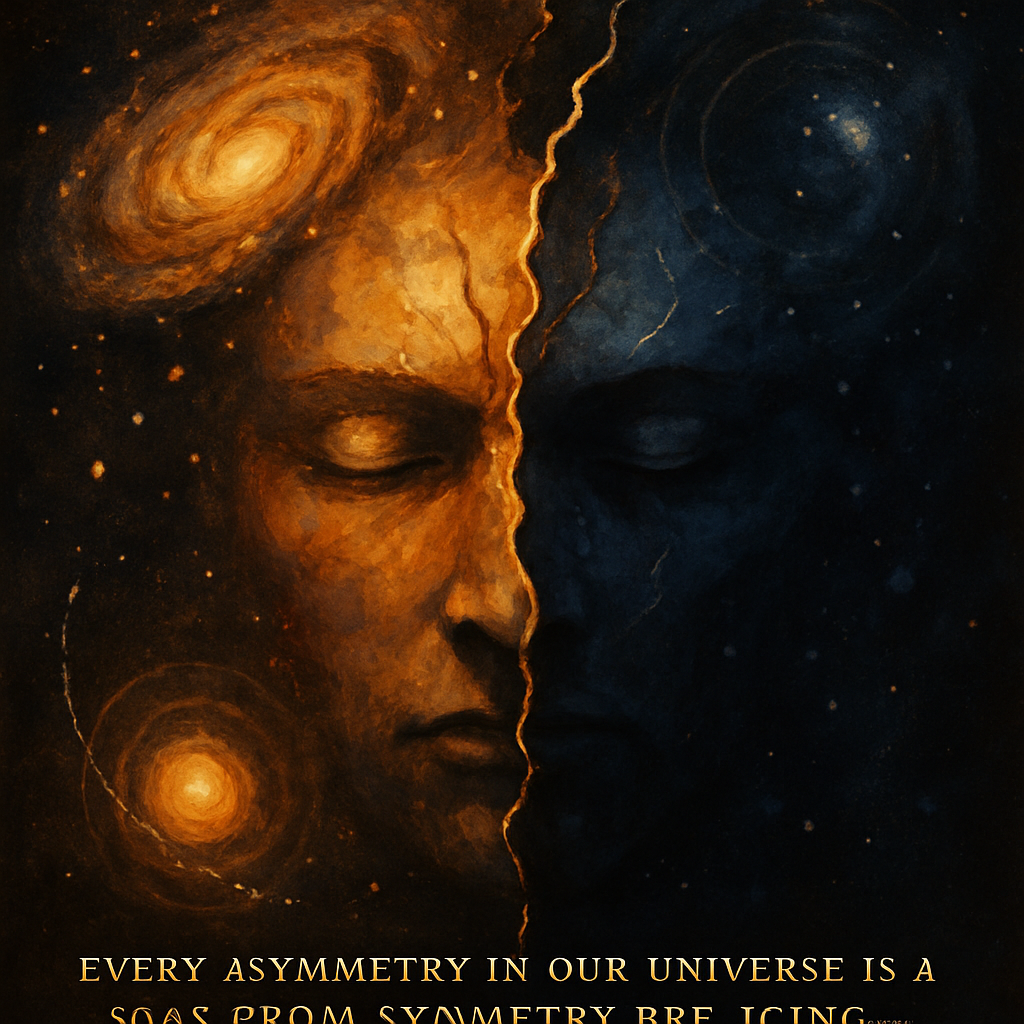
animate this concept: Every asymmetry in our universe (matter vs. antimatter, time’s arrow) is a scar from symmetry breaking—a memory of lost unity
Luma Video:
Open in new window
Leave a Reply